
💭 an exploration of the modern poet
how to make peace with your obscurity
if i told you that social media wasn’t riviting, i’d be lying. i guess that’s something i’ve had to come to terms with recently- the dual morals i confront as i denounce social media whilst simultaneously relishing in its benefits. recently, i’ve been thinking quite a lot about my relationship with social media, and i’ve come to the unfortunate conclusion that, although i wish i could remove myself from it entirely, there is no future for me and my career without some form of social media marketing. being a writer in the 21st century sucks- and i know i’m not the first to say it.
the other day, i found myself wondering how authors and poets of the past ever found success in a world so starkly disconnected and isolated. how had they ever gotten the word out- how had they ever debuted? but the more i thought about it, the more nuanced my thinking became. yes, most popular poets of the past were seemingly well supported from the start, their work quickly climbing the ranks and receiving due praise for their talent. but as onlookers, we do not recognize the intense effort those poets poured into simply getting representation, getting published- because only then could they ever be memorialized in history for their talent. so few people made it through the intense ritual of publishing a book or a collection, because although it was equally as unforgiving, to them, it was their only option. self-publishing did exist, of course, but it was unlikely to yield recognition or any sort of widespread following. so many writers found themselves drowning in a desolate ocean- gazing longingly at the sky above, but unable to save themselves from oblivion.
self-publication has become increasingly more accessible, which has provided many opportunities for emerging poets to get their work recognized. but, like anything else, it can be a double-edged sword. with the sheer amount of indie poets in the art scene today, it can be overwhelming for newer poets to feel comfortable asserting themselves into that already overpopulated community. just as pre-internet poets found themselves isolated and longing to be a part of that unattainable community of poets, it can be equally as isolating being such an insignificant member of an enormous community. it almost feels like, to bring back the desolate ocean analogy, we are drowning in an ocean in which thousands of others are drowning too- and we have no choice but to tread water and pray that we, of all people, will be chosen to survive.
nowadays, existing as a poet also requires skills in marketing and brand-building. if you want your words to reach others, you first have to prove that you deserve it. you must curate yourself into someone admirable, someone to be idolized & envied. you must seek to be praised for your talents like a goddess- your likeness perfectly embodied in each instagram post & story like an ancient statue of venus. you must become something to be admired- and if you do not accomplish this first, there is no hope of your work ever reaching the public eye.
i have found myself playing into this persona more times than i would like to admit. instead of asking myself, ‘what am i trying to say with this poem?’ i often catch myself thinking, ‘will i be understood?’ but poetry and art are not made to be understood- this is the discrepancy between the persona of a modern poet and the actual poetry itself. rupi kaur, one of the more mainstream poets of recent years, has built a following of over 4 million on instagram. and she has achieved this by marketing herself like any other influencer- selling her poetry books like skincare products, creating a persona that is digestible for every type of person, poet or not.
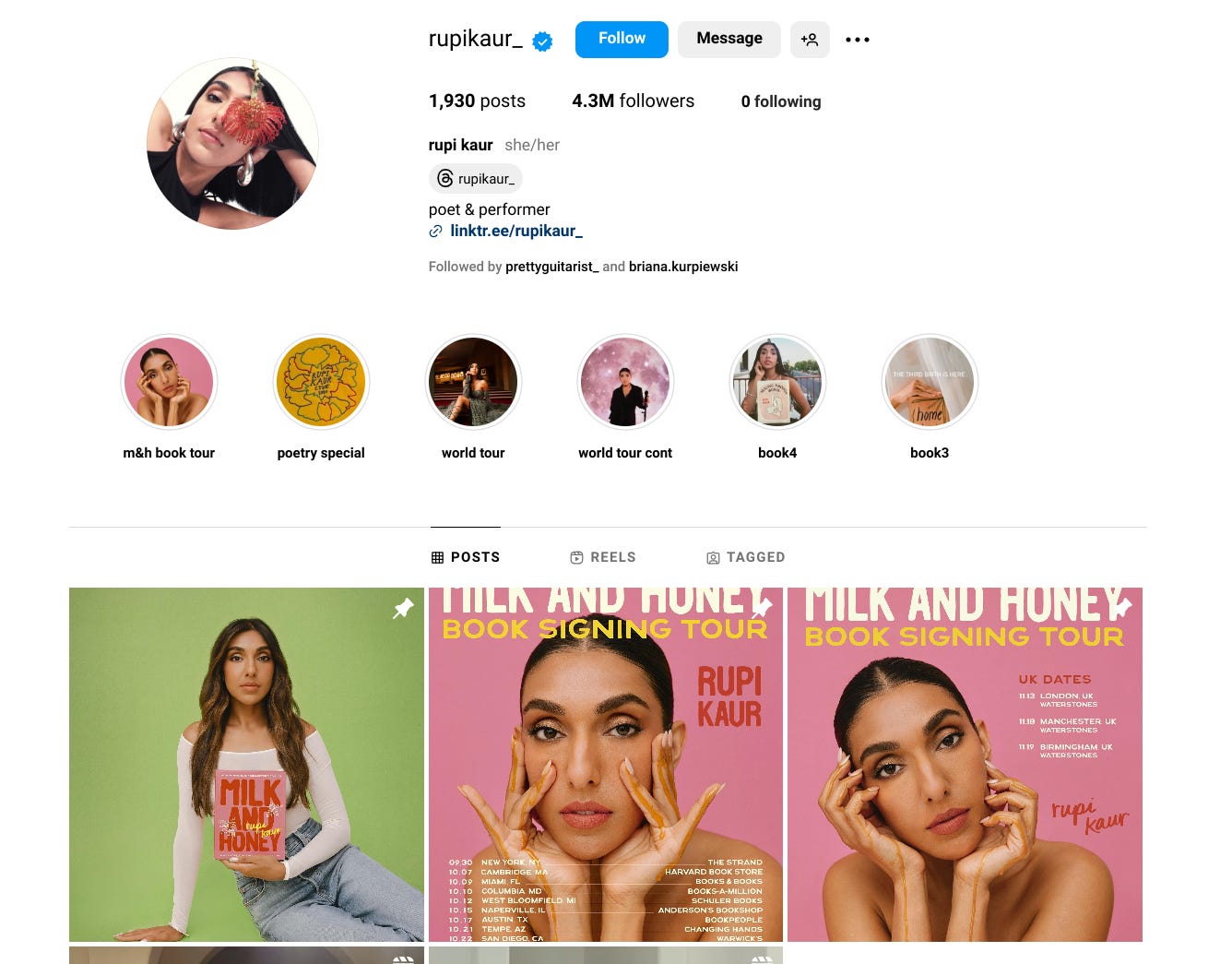
and look- i have my opinions on her writing, that isn’t why i bring her up. i do think it is important to note that she has introduced many young people, specifically young women, to the art of poetry. i bought her book ‘home body’ when i was in 7th grade, and i can say with full transparency that she inspired me, at least in part, to write poetry (although i do wonder now if i was inspired because of my desire to prove myself as more of an intellectual than her- i’ve always been a bit pretentious). i do not think that she entirely is the problem. in fact, i think that she has proven herself to be a victim of the problem. as poetry emerges into the limelight, we are forced to question its place in our capitalist economy- and we are ultimately left with two choices: a.) restrict your art to only the commercial & easy-to-understand facets, or b.) stay an outsider. remain unknown. if the success she has gained cannot be completely attributed to her work alone, then what is her secret? what makes her poetry and her brand so marketable, so popular? the answer is simplicity. when you create art that can be enjoyed or consumed by everyone, you are so much more likely to grow a following of people who appreciate the low-effort nature of her work. in a world dominated by short-form media- 7 second videos on tiktok, snapchat stories you tap through faster than you can even view them- it’s no wonder rupi has garnered the success she has.
but the thing is, there is nothing to be gained from catering to the masses. there is no lesson to be learned from only reading poetry you know you will relate to or agree with. attempting to force poetry to become mainstream inevitably creates a sealed echo chamber, out of which nothing emerges and into which nothing enters. ideas are not challenged, patterns are not broken, and nothing is remarkable. and the only way to escape this cycle of mundanity is by accepting your function as an outlier and accepting the obscurity that comes with it. maybe that’s what poetry has always been about- finding community in the most sparse corners of the universe, sharing art that is meant to be discussed and disliked, writing and creating not for notoriety or profit, but simply because we must.